
It has always bothered me how accounting is viewed and talked about. There’s a strange indignity to it.
We have heard praise to someone for being “strategic, not just an accountant.” And we’ve seen when a sitcom needs a character who is cautious, colorless, and constitutionally opposed to fun, an accountant is waiting in wardrobe. I know your mind just snapped a picture of that character. (I’d love a drop in the comment section the image you rendered!)
When you look back over the arc of accounting and the meaning it has had to the evolution of society, it’s an odd fate for one of humanity’s foundational technologies.
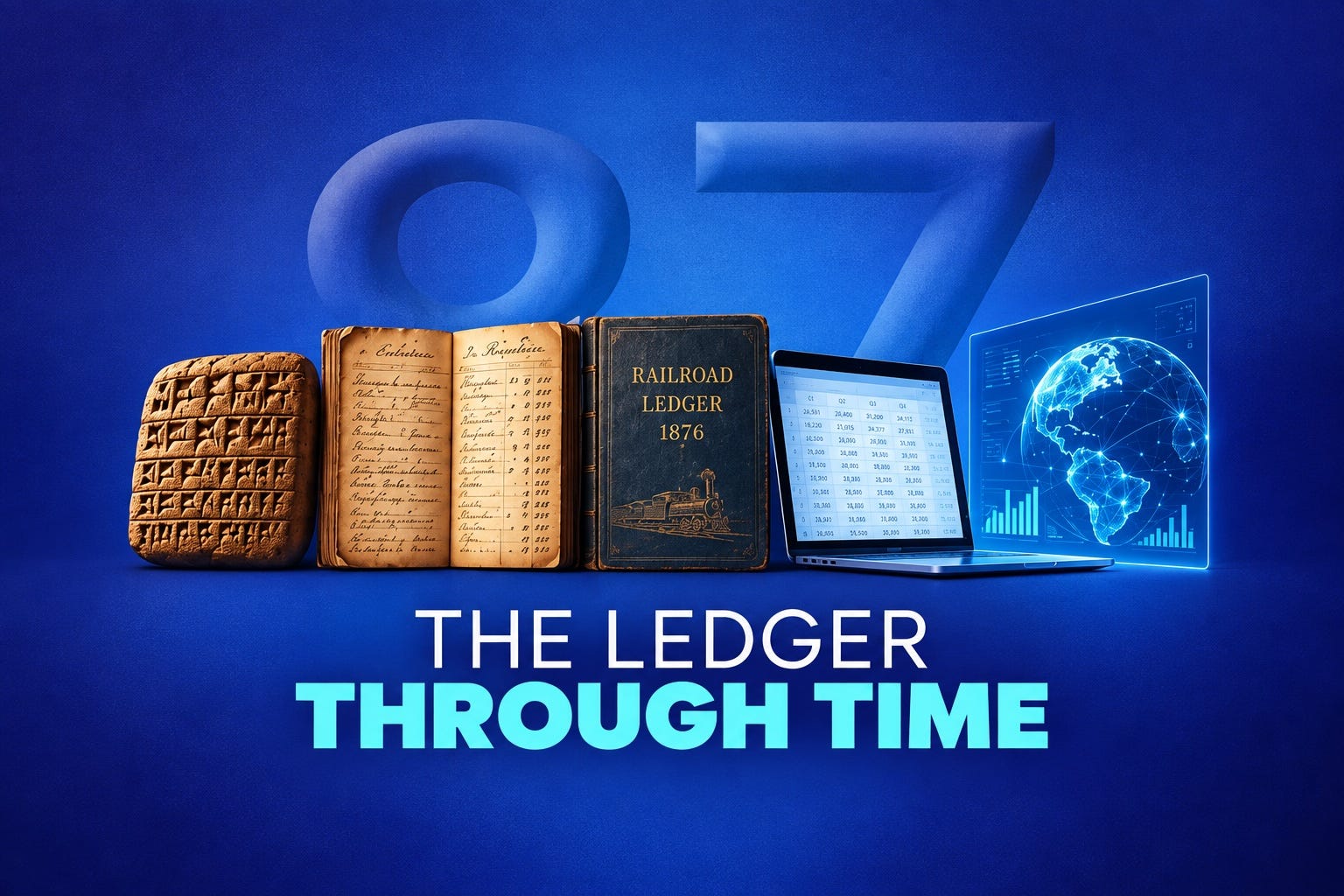
Experts believe that our capacity for language appears innate, that it resides inside of us and is acquired through exposure and interaction. Some of the earliest surviving marks from Mesopotamia were not poems or prayers but records of grain, livestock, labor, and obligations. Accounting started as a language, a way to communicate. The ledger helped establish large institutions because memory and trust do not scale. A ruler, temple, or merchant could act across distance and time because the language of accounting made resources and promises visible.
Accounting was part of a system that allowed an economy to exist.
Centuries later, accounting morphed into double-entry bookkeeping and supplied another leap. By placing every transaction into a connected system of debits and credits, it did more than keep a tidy record. It created a “business” model of the enterprise. Capital, inventory, debts, revenues, and expenses are recorded and become related to one another. An owner could distinguish wealth from cash and a viable enterprise from a busy one.
The accounting ledger became a commercial map and a source for objective and transparent comparative.
The operating system of industrial scale
Accounting’s next great moment arrived with industrial scale. Think about how difficult it would be for a railroad back in the late 1800s to measure itself if accounting had not existed. It’s so large and complicated, there’s no way a railroad could have seen itself without a system of accounting.
Nineteenth-century railroads crossed enormous distances, employed thousands of people, owned varied assets, and had to price and coordinate a network of hidden costs. There was no polymarket for railroads! Managers needed measures of cost per ton-mile, operating ratios, asset utilization, route performance, and capital requirements. The enterprise had become too large for intuition. Effective governance was made possible through accounting.
The same pattern appeared in steel, oil, chemicals, and mass manufacturing. The organizations that dominated the industrial age were also information-processing systems. Their leaders needed to know where money was made and where it leaked, which plant was efficient, whether integration would lower cost, and where capital should be deployed.
John D. Rockefeller plays a large role in the history of accounting. Rockefeller was not merely a magnate who happened to appreciate a clean set of books. He began his working life as an assistant bookkeeper. In his memoir, he wrote that this beginning gave him “great respect for figures and facts, no matter how small they were.” In his first partnership, he kept the ledger and knew all the finances. His extraordinary command of operational detail on yield, transportation costs, refinery utilization, and other key metrics provided Standard Oil with an advantage over its competitors who didn’t have anywhere near the level of sophistication on operating results. Rockefeller’s ledger wasn’t reporting the strategy. It helped create and effectuate the strategy.
When trust became accounting’s product
In the twentieth century, accounting gained enormous institutional authority. Capital markets needed financial statements that investors could trust. Securities laws and independent audits turned accountants into guardians of public confidence. The controller and, eventually, the chief financial officer rose in the corporate hierarchy.
In many ways, this was a victory for accounting. But, in other ways, this was also the beginning of narrowing accounting. The more consequential external reporting became, the more the profession organized itself around reliability, consistency, independence, and compliance. These are good things. Awesome for the interest of public good.
But the center of accounting shifted from What should this business do? toward Can this business prove what it did?
Could this shift in the main role of accounting be the reason many other adjacent occupations form to claim the future oriented question, What should this business do?
Think about the creation of these other adjacent professions. Investment bankers owned the language of transactions and capital, strategy consultants owned competitive advantage, corporate finance owned valuation, FP&A owned the forecast, information technology owned the system and data scientists owned prediction.
Accounting retained the past!
Granted this did not happen at a single point in time, but it was an evolution of the accounting role brought on through division of labor, regulation, specialization, computing, and professional boundaries.
The shame of it though is by the late twentieth century, the cultural image of the accountant had solidified. The accountant closed the books, enforced the rules, and was called in after the interesting decision had already been made.
Why the stereotype survived
This is where continued soullessness has permeated. The profession has realized for a long period of time that the perception of accounting does not match reality. There have been many attempts at escaping the stereotype by advertising against it. Remember all of those “Accounting is Cool” ads where accountants were in those bland suits but had sunglasses on to rep cool? We end the stereotype by changing the experience that produces it.
Accounting PR tells recruits they will become trusted advisers and will gain deep technical experience, yet many enter the profession and spend their first years documenting, reconciling, sampling, formatting, chasing support, and recording how they performed those tasks. During busy seasons, the hours can become punishing, precisely when the work can feel least valuable. The stereotype survives because it contains an uncomfortable amount of truth.
Accounting did not become unimportant. It became invisible.
One of the challenges accounting has in changing the narrative is we have established a high level of trust by performing consistently over a long period of time. When accounting works, nothing dramatic happens. The profession prevents disorder, and prevention is difficult to celebrate.
But have we allowed invisibility to become destiny? We’ve created a deep problem for ourselves because we have allowed our value to be described as producing accurate outputs rather than creating better decisions.
I’m not suggesting the way forward is to abandon stewardship and erode our most sacred asset, Trust. I think we have a large opportunity to expand upon trust to connect it to action where our work is closer to the decision-making process where we solve for helping management make decisions, now.
Accounting’s first age made economic life visible. Its second made capital markets credible. The age we are entering in should make organizations more intelligent.
That is a far more compelling story than “the back office.” It also happens to be true and up to all of us to validate this “renaissance” age.